By Lauren Shallow
*This review contains spoilers, as well as mentions of sexual assault.
Di and Viv and Rose presented by the Corseted Rabbits collective and hosted by Rumpus, is the Adelaide production company’s take on Amelia Bullmore’s 2011 play of the same name. Rumpus was an extremely welcoming theatre company; after briefly showing our tickets we were pointed towards a spacious, eclectic and couch-filled area, complete with a bar. While my friend and I sipped ciders we listened to the accessibility officer explain the venue’s contact points and clarify show specific warnings, like loud noises, extended dim lighting, triggering themes, and extended synths (we’re about to enter a world still gripped by 80s music after all).
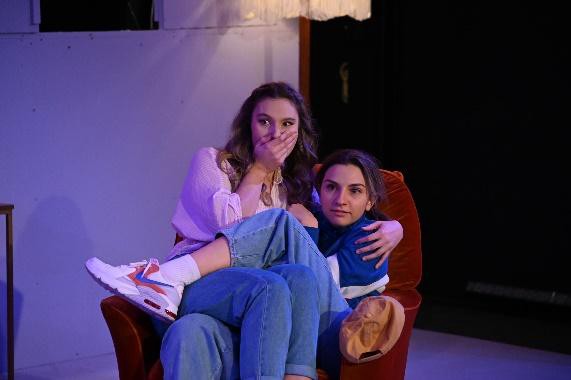
The show centres itself around the three British women who give the play its name. Di reminded me of a golden retriever initially, as she is friendly and extremely loveable. Viv, who sports a strong Northern-English accent, thinks about the world, perhaps too much, while remaining somewhat separate from it. Finally, Rose, an outgoing woman, whose high-pitched voice I could easily tell was Southern-accented and quite posh. These characters were brought to life by Isabel Vanhakartano (Rose), Julia Vosnakis (Di), and Georgia Laity (Viv), respectively. The play begins as the women enter university in Northern England, and we see them orbit each other, a community phone becoming the catalyst for their initial interactions. Rose befriends Di, inviting her to have dinner, which Di was surprised to learn was a home-cooked French dish. The two become fast friends, and eventually Rose pushes Di to introduce her to Viv, who Rose refers to as ‘war-time Viv’. This is due to Viv’s fondness for simple, long skirts and cardigans, which contrast with Rose’s popular 80s fashion, (all bright pink, mum jeans and scrunchies) a costume choice that immediately illustrates the character’s personality differences.

The three bond with one another, soon moving in together and creating a found family dynamic that is central to the play’s true substance. They encounter romantic struggles, as Di becomes infatuated with a girl she sits with at lunch, which the three call “the lesbian table,” and turns to Rose for advice…the promiscuous Rose says she simply asks boys to sleep with her and they say yes, they agree to disagree whether this will work for Di’s situation. Rose and Viv clash, they’re inherently different people and Viv has a tendency to lean more brutal than honest, while Di attempts to play mediator, however, the audience understands that they love each other, in their different ways. The narrative darkens during their final year of uni, after a man breaks into their home and rapes Di, afterwards they begin to sleep together in the living room, and attempt to hold their suffering friend together, urging her to approach survivor organisations. Di, despite her goofy nature, is stalwartly independent, and hates that her friends now act tentatively around her. She breaks after entering the living room one evening and encountering a heavy silence, and alleges that her friends have begun keeping secrets. This claim holds true after Rose reveals she has fallen pregnant, there are six possible fathers, and she wants to keep the baby, while Viv has received her dream job offer in New York. Their lives move forward, and physically away from their rental house, but they are nevertheless irrevocably changed by their experiences and by one another. I could say more, but I’ve already spoiled enough of the plot. Di and Viv and Rose centres around friendship, its changes and how women leading different life courses can stay linked to one another, but the play isn’t cheesy nor overdone. The actresses manage to bring life to their characters. Initially, I foolishly overlooked Rose; I thought she was going to be the archetype of the prim, sheltered but animated girl, yet Vanhakartano infused the character with liveliness beyond the saccharine, one-dimensional aspects we often see. Viv remained closed off for the story’s first half, but she was continually challenged by her friends, and Laity managed to expertly convey emotion through small details, a tone inflection while otherwise facially impassive, or tipping her chin slightly upward, as Viv feigned haughtiness. Vosnakis’ acting as Di encapsulated arguably three different versions of the character, the fresh teenage entering university, the survivor, and her older cynical self.

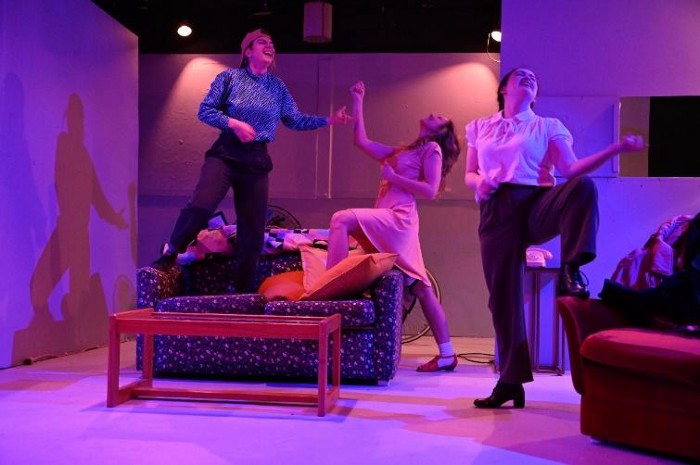
The play runs until the 24th of July, and regardless of whether you’re able to see this particular run of shows, I would highly recommend supporting both Rumpus as a local venue (found in Bowden) and the Corseted Rabbits as a collective, both are inclusive, talented and welcoming. Further, follow and support each of the actors (Isabel Vanhakartano, Julia Vosnakis, and Georgia Laity), I am sure they will continue to deliver performances and choose interesting projects well worth seeing, such as Di and Viv and Rose!
 On Dit