Interview by Sebastian Andrew
The merger between the University of Adelaide and the University of South Australia has been approved by the Councils of both institutions. As we’ve previously reported on the impacts of this decision on students, I was eager to hear a staff member’s perspective. I sat down with Professor Geoff Hanmer, an Adjunct Professor of Architecture at The University of Adelaide, to gain some insight.
Adelaide University is predicted to have 3100 staff, but the combined total of University of Adelaide and UniSA staff exceeds this figure. How do you reconcile this with the promise of no net job losses?
They’ve said no net job losses – or nobody will be made redundant until 2027 – which is probably true. But it doesn’t really deal with what will happen to contracted staff when their contract expires. I’m presuming that contracts probably won’t be renewed, or casual staff will be adjusted in number to suit whatever arrangements they make.
The whole idea of the merged university is to make it more productive, which means that eventually the University will lose staff. Whether that’s after 2027 or not, it’s still going to lose staff. I would imagine it will lose casual staff and contracted staff before 2027.
Was there adequate constant consultation with staff members?
Absolutely not. Staff were asked to comment on the Vision document, which was lacking in any content really. It was a series of assertions about how great the university would be in the future. Completely missing from that document were any reasons why this would be the case!
We’ve got two established universities – both of which have enrolments of well over 22,000, and thousands of staff. It’s going to be a very complex and difficult merger process because none of their systems are aligned: electronic systems that provide things like payroll, student learning management systems and so on. They all will have to be redone, or scaled up. This is not a small task. It’s going to be a long and disruptive process.
There was no consultation with staff beyond that?
No meaningful consultation.
How have staff concerns been addressed?
Most staff have been concerned they’ll lose their job, which is a pretty rational concern. I don’t think anyone knows any better now than they did when this idea was first proposed.
None of the detail of this has ever been released. That’s because the University is going to have to sack a significant number of staff. The general rule, if you’re doing this sort of thing, is to not to tell them beforehand, as it just makes it worse. Nobody’s being honest with the staff. Nobody’s saying, ‘look, it’s bound to have less staff in the future than it has in the aggregate now’.
The Premier the other day on radio talked about how the University would grow, and how that would attract more staff. It’s an assertion that the University will grow. I don’t see where this comes from. The number of domestic students is probably going to increase at the rate of demographic growth in South Australia, in addition to the forecast of an extra 6000 international students. 6000 is a very round number and I very much doubt that anyone has sat down to justify that 6000.
It’s possible the University will actually shrink over the next few years, because the place will be in chaos. Quite a few staff are going to leave voluntarily because if they’re any good, they can get a job anywhere in a heartbeat. These are all the people that we actually want to stay. There are about 150 researchers at the University of Adelaide who provide the bulk of our ranking and if they decide to go somewhere else, which they might, then the University is in deep trouble.
What was your reaction to Deputy Premier Susan Close’s dismissal of the National Tertiary Education Union’s survey results which revealed staff concerns about the merger?
I think that was very unwise of Susan Close. To say this to staff, all it’s doing is inflaming the situation.
The Premier and Close realised they’ve got to get this through the Upper House, and so the Premier has conceded that there’s going to be a parliamentary inquiry. They should have had an inquiry first, before they even started the process. That’s what the Premier promised: a public independent inquiry into all three universities in the state, and that the results of that inquiry would drive policy. Instead, what we’ve had is this rush to try and convince the Councils of UniSA and UofA to merge.
My question is – ‘All right, you’re going to merge them. What are you hoping to gain from this?’ And the answer is a resounding silence.
Mergers are vanishingly rare. They normally happen when you have universities that have got so small that they’re not viable. There are virtually no mergers of universities, and quite a few of them split.
Do you believe the University’s decisions have been influenced by political pressure?
Clearly they have. The University of Adelaide, of all the Go8 (Group of Eight) universities in Australia, has the highest percentage of low SES students. It’s done a lot to reach out to students across Adelaide who come from less well-off backgrounds, including myself. I was very fortunate to go to the University of Adelaide and it’s transformed my life as it does for so many kids who come from low SES backgrounds. The University of Adelaide has been pulling its weight in Adelaide and performing exceptionally for a university in a smaller state experiencing low economic growth.
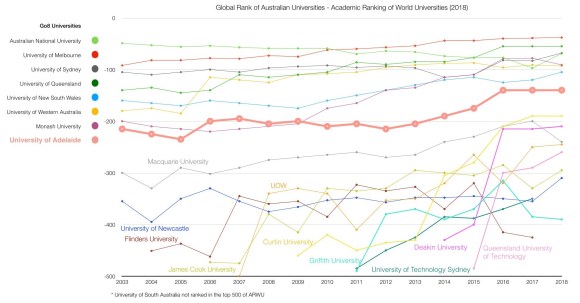
It’s in the Top 100 in both the QS and the THE (Times Higher Education) rankings, and it’s 101 to 150 in the ARWU (Academic Ranking of World Universities). The University of New South Wales has about as many students as the proposed merged university will have, but it’s been doing research for a very long period of time, and they’ve been struggling to keep their ranking going upwards. Other universities like ANU are in long term decline. Meanwhile, the University of Adelaide has seen a steady increase from 2003-2018, and is continuing its upward trend.
The Deputy Premier promised a new contemporary curriculum with courses geared heavily towards the needs of professions in industry. Do you believe this implies that certain faculties are at threat?
What does she think the Universities are doing now? Deliberately not trying to fulfil demand? Absolutely the opposite. Both Universities are very keen to provide an educational experience to students that will deliver them a job that will make them relevant to industry. I think there’s every indication that UniSA is probably better at that than the University of Adelaide, because the University of Adelaide focuses on research and UniSA focuses on vocational education.
But all the people who do Architecture, Medicine, Law, Nursing and so on, they’d be very surprised to learn that they weren’t being focused into an industry. So I think this is ridiculous, but we’re talking as if everyone at the University of Adelaide is doing classics or something like that or Greek, and then obviously they’re not. This is just ridiculous stuff.
Some opponents have criticised the merger for prioritising research over student culture. How do you believe this could be affected?
The idea of the merger is that you get some efficiencies out of the new University, both by sacking staff and having larger student cohorts, which reduces the amount of academic horsepower that you need to teach them. Then you transfer the surplus from that activity to research. That’s what they’re hoping for.
You’ll notice that all of the universities that are doing well in research (University of Melbourne, University of Sydney. University of NSW, Monash) all have terrible rankings from students simply because they have very large cohorts. Students are piled into huge classes where the academic has no chance of remembering anyone’s name.
This merger will definitely undermine student experience because at the moment the University of Adelaide scores better than any of the other Go8. If you look at the results of the bigger universities, which ‘Adelaide University’ is now trying to emulate, it’s clear that the student experience of those universities is worse.
One of the things that’s clear from that study is the bigger the university, the lower the chance that students will enjoy their experience there. Conversely, students are blind to ranking except when they’re actually selecting a university. Once they get to a university, they could be perfectly happy there no matter what its ranking, as long as they have a decent experience and their academics spend time with them. The University of South Australia scores very well on this, probably because their academics aren’t distracted by research. I’d hate to see that excellence in teaching being lost.
I hope that the parliamentary inquiry is a genuine parliamentary inquiry. I hope it hears from people who are independent, and I hope it comes up with an excuse for Premier Malinauskas to back out of this because he badly needs an off-ramp.
In the end, I don’t think the results will justify the cost.
 On Dit
2 replies on “Staff under the merger: An Interview with Professor Geoff Hanmer”
I agree with Geoff on all points he has addressed.
Casual and contract staff are always the first to experience ‘management efficiencies’. Most of the teaching is done on casual and short-term contracts. Semester by semester, if courses have sufficient enrolments, casual contracts are offered in blocks of teaching hours.
Having done that for a decade before being offered longer teaching contracts was not unusual. Research students on scholarships are offered teaching hours first. Up to 8hrs/week. Much of the planning around allocations focuses on this as a ‘top-up’.
The current trend is to push out more and more online-focused teaching resources. Short videos explaining concepts or tasks, in place of 50min lectures. And so on.
Having taught in all three ‘modes’ (on campus, online, mixed) none are ‘easier’ to do well as a teacher. Building relationships with students is the core of teaching: their relationship to what they’re learning, and with the people teaching them.
The real problem with teaching in universities is the fashion for cutting back on the time students get to spend with teachers. Which is fatal. Students can pass tests, and submit assessments, based on ‘learning materials’, with little input from teachers. But their experience as learners suffers.
Learning is a collaborative, social experience. We learn more, and better, and feel better about both when they have more time with a teacher.
You cannot teach culture in a 15 minute video, or dozens of them, anything like the way you can in a room with students. And the experience of being in a cohort with other students is much stronger than regular in weekly zoom or teams or FaceTime or whatever.
Then we jump into accessibility for students. Online is accessible – for a certain kind of accessibility – if it’s very carefully designed and delivered. It is super easy to get that wrong. And a lot of work to get right. And if we’re cutting back on delivery staff, we better make up with it through designers and specialist course development.
When we’re talking about ‘increasing productivity’, I hear ‘making employees do more, with less, on the same pay’. And as a student with experience across disciplines, and universities, my response to all of this is: “this isn’t going to be effective, except to cheapen the whole thing.”
Student experiences have been systematically displaced to transform universities from places of learning, into employee training camps – where the employees pay for the training their employers demand prior to hiring. And the few who survive postgraduate research training can look forward to fewer opportunities not dependent on a corporate employer.
We pay for training that’s increasingly poorly delivered because the human is removed, so that we can be available to corporations who expect more for less. This is what ‘success’ looks like.
LikeLike
[…] In July, On Dit spoke with Professor Geoff Hanmer about his concerns surrounding the merger. […]
LikeLike